Marketing and Advertising with Chris Newton: direct marketing
Showing posts with label direct marketing. Show all posts

Tuesday, August 9, 2011

World's Most Successful Business for his Industry

Sometimes in our rapid pace technology driven world, we miss the most obvious basics that can create a competitive leap.  Now I know you’re NOT in the dry cleaning industry.  But when someone in a crowded industry with 8% of the outlets has 40% of the business, maybe the ‘basics’ have something to teach us ...

Mel Shapiro was a superstar in the crowded US dry cleaning industry (he had 126 competitors across the country!). Even though he had just 8% of the outlets, he managed to secure 40% of the business. 

In fact, his main location did more business than any other single outlet in the WORLD!

So what's the secret to his extraordinary SUCCESS?  It's not the way his factories are run.  It's all about his customer interaction.

Some brief examples. His competitors have their management desk out the back. He places his IN FRONT of the counter. On the CUSTOMER’S side! His competitors' teams make do with casual clothes (consistent with the industry). He wears a suit. 

It's his mindset, and the mindset of his team, that creates success, and it can work for any industry.  He gives four rules of success:

No. 1 KEEP A SMILE ON YOUR FACE.

“Happy people work better. They convey that message to the public. (It’s as if) you are the conductor of an orchestra… What are you conducting? Is it a funeral march? Or is it a happy tune? You must have a positive morale and everything you do must give that feeling…”

No. 2 KEEP YOUR PROMISE.

There’s that “DO-WHAT-YOU-PROMISED-YOU-WOULD-DO” again. Yes, there’s that “DO-WHAT-YOU-PROMISED-YOU-WOULD-DO” again.  By the way, not only should you ‘deliver’ as promised, make sure your clients KNOW you delivered.  That’s a key distinction.  TELL them or how can they value what you’ve done for them?

No. 3 MAKE A GOOD PRESENTATION.

“What does that mean? You have to clean up your stores or office. Your sign programs have to be good. Get rid of that cluttered look. Develop a 'distinctive' look. Hire a graphic artist, and be prepared to PAY for quality…”

No. 4 DO GOOD QUALITY WORK.

“Yes, it’s important,” stresses Shapiro. “But, the difference between one supplier and the next isn’t THAT great. The secret is to capitalise where you can project a dramatic difference.”

What are the messages in all of this?

From an advertising perspective, it’s clear that until ALL these things are in place, the advertising proper can’t do its long term job. As well, it’s evident that, unless you have a particular flair in the area, it pays to call in professionals to look at your image… décor, signature, uniforms… and staff training.

Wouldn’t it be nice to steal the march on your competitors… suddenly appearing one day with a brand new “packaged image and marketing thrust” that’s ten years ahead of them? I don’t know about you. But the idea is irresistible to me.

Wednesday, July 20, 2011

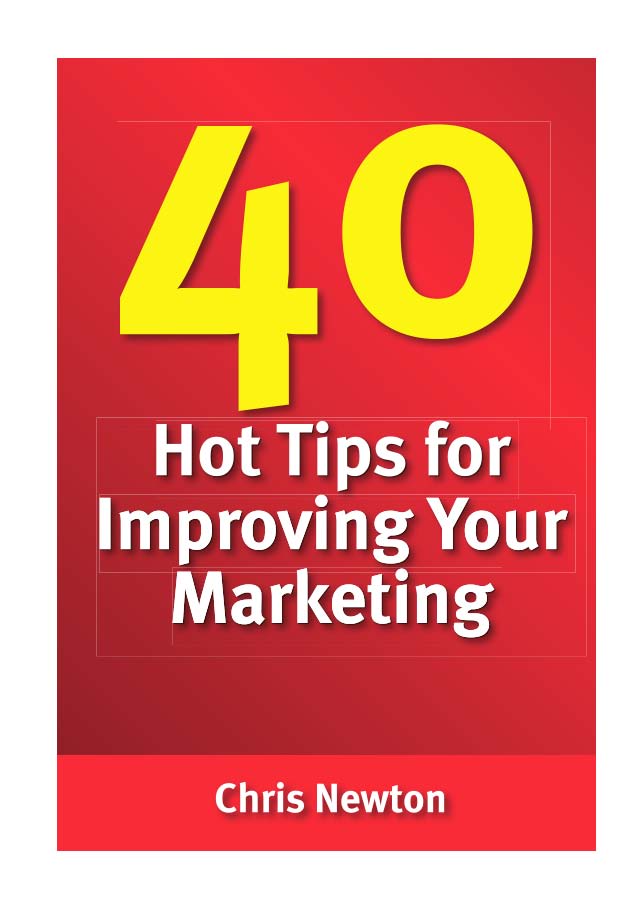
Featured Report: 40 Hot Tips for Improving Your Marketing

Inside this free report are 40 hot ideas for increasing the effectiveness of your marketing. These ideas have been drawn from a multitude of sources over time. They are the results of campaigns conducted by various leading advertising agencies and marketing companies.

How were the comparative results obtained in some of these examples? 

By using split run tests. Only ONE element (e.g. offer, headline, photo) is changed in the campaign in any one test. By isolating a feature like this, marketers can accurately track which version worked better and by how much.

A note of caution...

These results should be taken as indicators only of what might occur if re-done right now, today. Human nature doesn’t change, but lots of other variables do. And the test results apply to a multitude of different campaigns and products. So, take the results more as guidelines as to how you might trial changes to your own marketing, to lift response. That said, I'm sure you will find great value in reading about these 40 elements that have been tested, and how they have increased response rate time and time again.

Use the contact form below to request this free special report.  Ensure that you enter into the contact form the name of the special report so we know which one to send you.


Friday, July 15, 2011

How OUTRAGEOUS are you prepared to be in your guarantees?

When a client phoned me, he was obviously frustrated. "We’ve got the world’s best auto security locking system, but our ads barely pay for themselves” was his opening remark.
 
I just happened to have a copy of the magazine he’d advertised in, so I grabbed it. His ad had a good position, right hand page, early in the magazine.
The headline on his ad was ‘STOP THIEF’ (set under a big red stop sign). The copy then opened up with “No longer is your car at risk with the such and such security system”, followed by a list of bullet point features (incidentally I changed the name of the product for reasons you'll see below) …
Fairly standard stuff … features like: Easy to operate, self-locking, etc. But then, ‘hidden’ in the third bullet point was the statement: ‘Ignition suppression which completely and totally makes it impossible to start the car when then system is activated.’
My first reaction was that the client had lost a powerful opportunity to sell his system. He’d fallen into the trap of trotting out a bunch of fairly standard features, while what I saw as his BIG benefit was hidden away in the third bullet point.
Interestingly, while he was on the phone, I started flicking through the other ads in the magazine. Lo and behold … there was another ad a few pages further on … and its headline was ‘STOP THEIF’, and it too had a bunch of bullet points. This second ad was for the much cheaper security device, a steering wheel lock. No comparison to Mike’s high tech solution, but because they both had similar bullet points, appearing to be a competitor.
I challenged him: “Mike, you claim it’s impossible to start the car?”
“ABSOLUTELY IMPOSSIBLE!” was his emphatic response.
“OK, here’s the deal”, I responded with my entrepreneurial adrenalin starting to surge through my veins. “I’ll write you an ad FOR NOTHING, and let’s see how it works. You run it and if it beats your old ad, and you continue to run it, then we can talk about a fee.”
It didn’t take more than twenty minutes to write the new ad. There was a man in a suit standing in front of a very expensive sports car … and the headline read:
I was convinced it would absolutely blitz the marketplace. Perhaps get him loads of PR too, as the media picked up on this outrageous guarantee. I was really excited with this ad, and eagerly sent it to Mike.
Now, for the real test. The only place that counts. The market.
So, how did my ad work against his original bland ad? Well, I’d love to tell you my ad with the totally outrageous guarantee statement did create an avalanche of orders. I’d love to tell you that … but I can’t. 
You see, for unspecified reasons … Mike never ran my ad. I’m still trying to figure out why. (I think I really do know!)
Still, this should serve as a challenge to YOU. Are your communications bland? Are your ads making the same ordinary statements that your competitors are making, that keep your great product or service in mediocrity?
Think outside that box! What are your compelling guarantees? What COULD they be that’d set people’s imaginations on fire? What sets your product or service apart that will bring prospects to you in big numbers? What is it about your product or service that takes the focus right off price, and has people knocking at your door, saying “I WANT THAT!”?

Thursday, July 7, 2011

Marketing and the Pareto Principle

The Pareto Principle, or 80/20 Rule is not new.  In 1941, Joseph Juran named it after Italian, Vilfredo Pareto, who’d observed that 80% of the country’s income went to 20% of the population.

In 1979, American Airlines identified that just 80,000 of their 25 MILLION travellers (3.2%) were generating 65% of their business!  This revelation saved them millions on wasted advertising.  

In fact, that revelation changed the face of marketing for airlines and many other industries with “frequent buyer” clubs.  

Savvy businesses reap huge profits by focusing on their ‘A’ clients who spend the most.  Hard to believe with this knowledge, the vast majority of businesses still don’t even segment their clients into A/B/Cs, let alone tailor communications to the ‘goldmine’ 20%.

Thursday, June 30, 2011

A red hot lead-generating white paper...

In this blog article we'll pick up from where we left off with how to craft a white paper that positions your business as ‘the authority’ and gets qualified prospects to ‘put their hand up’.  If you have not done so already, it might be an idea to read the first blog entry and second blog entry I have done in this series.

Example 3#: A white paper for the ages

As a business owner you'll no doubt identify with the white paper title and content we created for Sheridans Accountants and Financial Planners.  More specifically, the principal of Sheridans created the content. Our task was to help mould it into a ‘marketing tool’.
As you’ll see, the white paper asks the questions business owners are thinking, and gives simple solutions to those questions.  Each of these solutions is then supported with case studies and statistics taken straight from their client files.

Importantly too, the white paper provokes the prospect into thinking about different ways they can increase their profit, grow their business and build their asset base. Or to put that another way, to quantify the things they’re MISSING OUT ON now.

And of course the solutions eloquently showcase Sheridans' unique service and standards WITHOUT being ‘salesy’.

Being able to highlight your strengths through the medium of asking the right questions is a very powerful skill in creating a white paper.

However, a word of warning.  Remember, the white paper must not look like a brochure for your business.  The white paper must be a document designed to be genuinely informative, not simply to try to sell your services.  It is best to imply the wisdom of using your services through your case studies to demonstrate how you do business.  That said, your white paper must still have a call to action at the very end.
In my next blog entry in this series we'll look at one final white paper that netted 374 leads (and counting!).  Make sure you sign up above to ensure you receive all entries in this series.

Wednesday, June 15, 2011

Sales Letter and Copywriting Clinic

Before I start, let me say this is an example from our archives.  So if the ‘technology’ references seem somewhat archaic, bear with me.

You see, the copy structure and approach is the message.

This was an actual sales letter (left) inviting me to attend the release of a new software product.


You will I trust get value from being an observer to the marketing blunders this company made.

Not surprisingly, I changed the name of the company.  The REAL company is one you’d recognise immediately.

Before you go on, scan the letter they sent out to who knows how many thousand ‘prospects’.

The Curse of Assumption

Okay, so the REAL company is a big brand.  You'll know it.  But does that mean you know as much about their XANADU 3000 as they assume you do?  And will you care?

A huge mistake in writing a sales letter (or any communication) is assuming that the prospect will care about the business, the service or product, or that they'll even stop what they’re doing long enough to try to peak their interest.  They won't!

Your reader is at the wastebasket 

Write your letter picturing the prospect reading your letter by their wastebasket.  Or they have their finger poised on the delete key.  You have to create a letter that makes it impossible for them to discard it.

And DO NOT assume that because you live and breathe your business, and your products and services, that someone ‘out there’ in the marketplace will too.

Most likely, when your prospect woke up this morning, they were NOT thinking about you!  And they’ll go through the day and go to bed at night, and chances are, they won’t have given your business a thought.

Coming at your communications from that perspective, it makes you realise that you have to work many times harder to grab their attention and keep it past those critical first few seconds, and then to motivate them enough to ACT on what you want them to do.

Turn the table on yourself ... 

How many sales letters have you binned?  How many emails have you instantly deleted?

Are your sales letters stopping your prospects in their tracks and commanding their attention?  Or are they rambling on about how good your company is, or that your computer division was established in 1984?

Now, just in case you feel this letter example ISN’T a sales letter, and that it's an invitation … and therefore doesn't need to 'sell' ... rest assured its objective IS to ‘sell’ something.   Its objective is to ‘sell’ the reader on giving up two hours to come to an event, reorganising their diary, and braving the traffic snarls to get there.  It IS a big sales task.  And that's not even the first sale.  The first ‘sale’ is getting your reader to stop and read your first paragraph.  Make sense?

The 'WHO CARES? test'

Whenever you write anything, make sure you give it the ‘WHO CARES? test' first.  If it doesn’t compellingly grab the reader’s attention, hold it with riveting advantages and benefits that demonstrate how you will help them to save money, increase productivity, look younger, feel fitter, get more sales, increase their profits, or whatever, then it WON’T pass the 'who CARES' test.  Don’t waste your time sending it until you’ve re-worked it massively.

How to fix this letter

Here’s the irony.  The XANADU 3000 may indeed be some amazing new innovation that will revolutionise your entire working environment.  It may quadruple your productivity.  It may cut costs by 48%, or enable you to cut three weeks off your delivery schedules ... or any one of a myriad of benefits.

But from that letter, you ’d sure NEVER know it.

The letter suffers from ‘product peddling’.

That is, it is ‘we’ focused.  It’s all about the writer’s fascination with their company and their product, NOT what that product will do for you or me.

As well, the letter suffers from bland generalisation syndrome.

It sounds impressive; ‘… addresses the changing data capture environment by delivering the highest level of applications flexibility, without the usual penalty of performance degradation.’

But what does all that mean?

The key to powerful communication is to be SPECIFIC.

If your product delivers a 48% cost cut, don’t just say it will ‘cut costs’.  Say it will cut costs by 48%.  If customer surveys have shown that it cuts 21 days off delivery times, say so.  And go on to say that, for the average user, this translates into over $40,000 a year in savings from stock control efficiencies.  And that 27 of the users have attributed winning new contracts worth a collective $4.7 million because of their faster delivery times.

Can you see where I’m going with this?  Once you learn how to write in this compelling, benefit oriented way, you’ll truly revolutionise your communications.

You’ll win more business.  You’ll increase your profit margins.  You’ll begin to gain an unassailable hold on your niche market.  And your competitors will wonder what you’re doing.

Does that sound like something you’d like to take on board?  If it's made you feel that way, it’s because I simply did what the letter above failed to do.  I focused on what’s in this ... for YOU.

Simple, isn’t it?

If you want to learn a whole lot more about how to write amazing communication pieces, I've developed a complete writing e-program, 'Write and Design your own Ads, Sales Letters, Brochures, Flyers and Sales Presentations'. 

For more great articles, examples and tips like this, subscribe to this blog.

Monday, June 13, 2011

The Concept of ‘Soft Dollar’

The concept of ‘soft dollar’ is a simple concept. But hardly any businesses harness it effectively. 

It allows you to value add to existing clients. It allows you to develop strategic alliance relationships that get you endorsed into other client databases ... and it gives you the tools to take away the focus from price and minimise the need to discount. 

So what IS ‘soft dollar’? 

In a nutshell, ‘soft dollar’ is something you have, or can create, that has a HIGH PERCEIVED VALUE, but costs little to produce or source. 

Take a pizza store. That’s an obvious one we’re all familiar with. 
The first pizza they sell a customer is encumbered with all the overheads ... wages, rent, power, insurance, advertising, etc. 
However, if they were to offer a SECOND Pizza FREE ... what’s the ‘hard cost’ to provide that second pizza? Some flour, water, cheese and a few extra ingredients. Maybe $3. Yet the perceived value is the same as the first ... Let’s say $12.
This is a classic example. That $3 pizza, positioned as a $12 bonus, can be (and has been) harnessed as a potent marketing tool.
In a similar vein, a beauty salon may offer a $20 hair styling as a gift. Perceived value, $20. Yet, the delivery cost of that service may be $2.
We’ve helped countless clients ... in beauty salons, fitness centres, health care, retail, automotive, financial services, real estate, design and construction, travel ... to rapidly acquire new customers through this concept. It is a concept you must constantly seek to apply. Because it IS so powerful.
Let’s have a look at a few more examples. Take the situation of a professional services provider.
Virtually any professional may use this same strategy. Naturally it has to be ‘packaged’ in a professional and appropriate way, depending on the profession. But the concept is equally as potent.
Take an interior designer. This person may charge out their time at say $150 an hour. It’s VALUED at $150. But it doesn’t cost $150.
The positioning of this offer is critical. If the consultant is seen to be promiscuously giving their time away freely without positioning it correctly, then it loses much of its value.
On the other hand, if this professional ...
  • positions the hour as an exploratory consultation, valued at $150 and ...
  • dimensionalises the value to the prospect of what they’ll be doing in that hour to analyse, advise and recommend, AND they ...
  • give reasons WHY they’re prepared to invest that time with the prospective client, an ‘investment’ in the prospect to that the prospect can fully understand the depth and breadth of the designers services and expertise ...
THEN ... this becomes a classic harnessing of ‘soft dollar’ strategy.   The consultant could launch a whole campaign around this strategy, aimed at highly targeted prospective clients.
Every business can harness this very powerful strategy. Apart from positioning an hour of your time in this way, your ‘soft dollar’ could be: 
  •  one of your own low cost high perceived value products that is related to, or enhances your main product offering in some way. An extended warranty perhaps.
  • a complementary product you source from someone else. You supply fitness memberships, you ‘package in’ a $55 voucher from a local massage therapist or beauty salon.
  • information you ‘package’ into a special report. This one is SO powerful, and so few businesses really harnesses it effectively. (For more great tips, grab a copy of our e-book '21 Tips to Creating an Effective White Paper' ... you'll need to put "21 Tips E-Book" in the comments field)
  • an audio tape of a seminar you’ve presented to prospects an interview you’ve scripted to give solutions to hot issues of the moment
The possibilities for ‘soft dollar’ are endless. If you don’t feel you’ve got the expertise to do the packaging, don’t let that be a reason NOT to do it! Find someone who can record a seminar, or a marketing professional who CAN put together a report of packaged information. 
 
Offering packaged information has been recorded to produce up to a 3,000% increase in leads. So it is worth doing.

We'll be really delving into white papers soon, so sign up to this blog to make sure you don't miss that series of blog entries.

Tuesday, June 7, 2011

The Truth About Advertising

For years decades there has been a debate as to whether ads must be kept brief with lots of white space and few words.  The reasoning being that 'people won't read all those words'.   The other side of the debate, advocates insist that ads with a LOT of words, almost no white space and maybe even no photo will work many times more effectively.  So which is right? ...


Well, to answer that, we need to go back to the very basics and ask: What IS advertising?

First, here's what advertising is NOT.  Advertising is NOT 'getting your name in front of the public'.  If anyone tries to tell you that, they're wrong.

Advertising is 'salesmanship'.   It is the act of selling a prospect on what you have to offer.  That 'sale' may be to call your office and make an enquiry.  Or to walk into your business and browse.  Or send off for information.  Or agree to make an appointment.  Whatever the 'sale' is for your business, it IS a sale.  And to achieve that sale, your advertising has to SELL.

Often in my seminars, someone will insist vehemently that the brief copy or 'bullet point' form of advertising is the ONLY way to go.  My response to that is to invite them to the front of the room, and allow them to convince the audience to buy from them.  BUT with one important caveat they must only use 100 words or less.  They simply can't do it.

You see, when we SELL in person, we tell our 'magic story'.  We unfold our benefits, use persuasion, and show passion and enthusiasm for our service or product.  To try to put that passion into 100 words, or clinical bullet points completely stifles the power to communicate.

So why we give ourselves that handicap when we advertise whether in print, in a sales letter, or on a website, or in a brochure?  Especially as these are far less effective and engaging forms of communication than in person.

You know, I've been direct marketing for well over 25 years.  Direct marketing is a discipline where the ONLY 'truths' are the RESULTS.  And I've proven time after time that, when a product or service has to be 'sold' when presented in person, it needs to be sold in an advertisement or other promotional communication.

Not so long ago, I delivered a workshop on advertising, where I invited participants to submit their ads prior to the event, with an offer to re-work them as part of the seminar.  Here one of those 'before' and 'after' examples.


This ad (or flyer in this case) above on the left was submitted by one of the attendees.   It had lots of white space and no 'selling copy' and a giant logo as the 'headline'.  And it wasn't working.

My re-write on the right is copy intensive.  MOST IMPORTANTLY, it has a compelling headline.

Let's get this straight.  Your logo is NOT a headline.  It does absolutely nothing to give a prospect reason to read on.

FACT: The headline you write for your ad can impact the response you get up to 19 TIMES. Look at that another way.  Write a powerful compelling headline and it's like having as many as 18 more placements of your ad.  For FREE.  That is how important your headline is!

And what about the copy intensive copy?  When you read the copy in the re-write, you get absolutely drawn in to the 'story'.  And you feel more and more compelled to do something about avoiding those toxins in your body.  Never ASSUME the reader will KNOW all these things.  They DON'T!  And when they don't have reasons to act, they'll simply flip the page and get on with their lives, oblivious to your 'magic story'.

Now, if you're thinking, "Sure it all sounds good, but I can't write like that. I'm not a copywriter", I've got some good news for you.  I didn't have to write most of this copy either.  I simply went to the A&B Water people's own website, and it was all there!  Hidden away.  When they were gathering and presenting facts on their website, the 'pressure' to write an ad was off them.  And they've written some very compelling copy.

You see, if you know your business, and you have a passion for your product or service, you CAN write compellingly.  It's just that most people TRY TO WRITE AN AD, and freeze.

Here's some of the compelling copy that I 'borrowed' for my re-write ad:

Ironically, in order to kill some of the live micro-organisms in our water before we drink it, even more dangerous chemicals are added.  What may shock you though, is that perhaps the most troublesome is chlorine this potent chemical reacts with organic material in water, such as leaves and other decaying vegetation, to produce hundreds of chemical by-products known as "trihalomethanes," or THMs.

These are suspected of causing birth defects and certain kinds of cancer if consumed regularly in drinking water.  Then there is fluoride.  Fluoride is a very potent poison that is suspect as a factor in bone diseases, including cancer.  New studies are also beginning to surface that seem to indicate that long-term, low-level consumption of fluoride in drinking water may be linked to increased susceptibility to hip fractures in older adults.

Well, you get the picture!   You'll see there is a vast difference between this thought provoking and compelling 'reason why' copy, and the previous brief copy that is passive and does nothing.

When the owners of this company saw how I'd re-done their previously unsuccessful ad flyer, it was an absolute revelation to them.  They couldn't wait to get a copy of my mock-up version.  It had hit them that they had been missing out on communicating their true reasons a prospect should buy.  And that meant they were missing out on a LOT of sales.  Maybe 18 out of every 19.  Who knows?

Click here to discover how Chris Newton can help you with your advertising and marketing.