Marketing and Advertising with Chris Newton: marketing tips
Showing posts with label marketing tips. Show all posts

Sunday, July 31, 2011

Mapping out your Master Strategy

If your business is like most businesses out there, you may sporadically do some unconnected, unrelated promotions, but have no real master strategy. 
As I'm sure you have discovered, this approach produces varying outcomes, and offers virtually no measurement or accountability. 
And when these random promotions DO capture leads there’s typically no system for handling them. They'll get misplaced, left so long they go cold, or mishandled because there is no follow-up system and no one has been assigned responsibility.
This results in massive wastage of marketing dollars, and massive inefficiencies, and ‘leakage’ of sales opportunities that should have been in the bag.
Now, this may not accurately reflect your situation. But even if there is a shade of truth in this scenario, you need to fix it now! 
TEN STEPS to a Lead Generation Master Strategy
A Lead Generation Master Strategy involves mapping out a series of highly logical steps, from lead to sale and beyond. This should be done before even considering the ‘creative’ elements of the pieces. 
1. Set Sales Targets. How many new sales (as distinct from repeat customers) are required in a given period to achieve the revenue targets outlined in the overall marketing plan. Define this targeted figure and you can work backwards to determine the activity required to get it. Starting with …
2. How many leads are required? Determine the conversion rate of leads-to-sales which will determine how many LEADS must be generated to achieve the sales targeted in step 1. 
3. Determine the ‘acquisition allowable cost of a lead’. As a simple example, if the company is prepared to invest $1,000 to get a SALE, and 1 in 10 leads turns into a sale, then the ‘allowable’ to get a LEAD is $100. Simple concept, but few companies know these figures.
4. One Step or Multi-step? Clearly, the bigger the buying decision, the more steps will be needed from initial lead to serious prospect. EACH promotion will have its own strategy. A website generated enquiry for example, may be followed by a qualifying phone call, sending of information with a promise to follow up, a follow up phone call, fact finding meeting, demonstration, proposal, further follow up call … and so on. It’s a system, not ad hoc activity. 
5. Sales Processes. What process will maximize sales? This depends on the nature of the product or service, and how ‘warm’ and ‘pre-educated’ the lead is. 
6. Target Markets. The correct selection of target markets impacts on your outcomes up to 1,000% or more. This one fact provides you with more leverage than virtually any other in your entire marketing thrust. What are your best target markets for new leads? The logical ones are not necessarily the best. 
7. The Matrix of Activities. When the various media options are selected, a matrix can be drawn up. This matrix shows at a glance all the efforts to be tested, dates, response lead times, and most importantly, the cost per lead and cost per sale from EACH promotion. Like the conductor of an orchestra (with the overall objectives as your music sheet), you can increase the intensity of various promotions, add new ones and reduce or fade out others as the individual performances are analyzed.
8. The Allocation of Responsibilities. Once the processes have been flow charted, responsibilities need be established to ensure that the processes identified actually happen.  
9. The ‘Creative’. Being creative is fun. But actually, it should be the LAST thing you focus on. Here’s a key fundamental truth: Once the strategy is right, the creative will come. But good creative with poor strategy will never work effectively. 
10. The Review Process. At key points in the implementation of the Master Plan, perhaps monthly for some objectives, perhaps campaign by campaign for others, review the outcomes. Are you achieving what your overall plan requires. If not, what change in direction do you need to take to get back on course?
This approach takes discipline and constant attention. But it’s so analytical, and structured … it forces you to be more successful in your marketing. And how bad can that be?

Wednesday, July 20, 2011

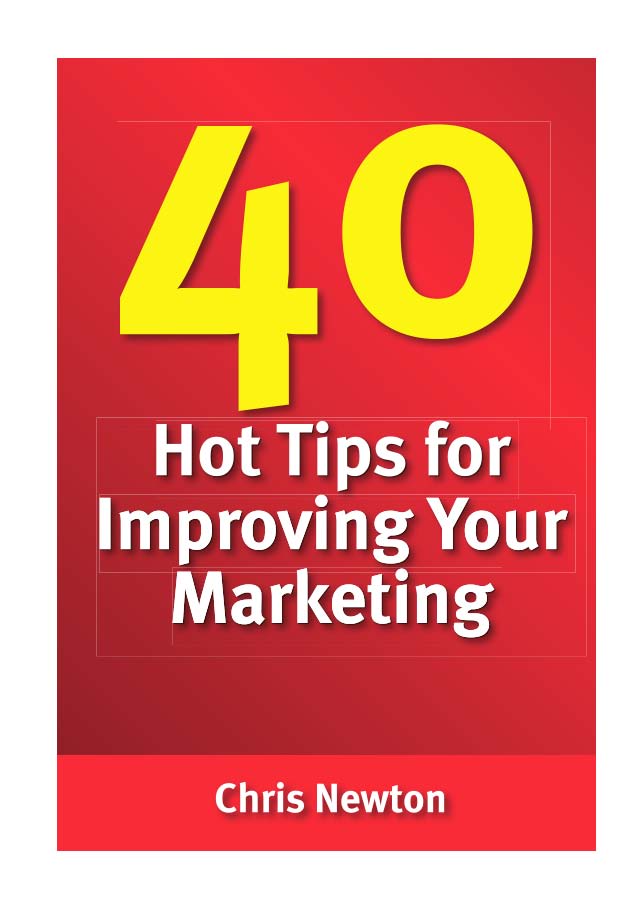
Featured Report: 40 Hot Tips for Improving Your Marketing

Inside this free report are 40 hot ideas for increasing the effectiveness of your marketing. These ideas have been drawn from a multitude of sources over time. They are the results of campaigns conducted by various leading advertising agencies and marketing companies.

How were the comparative results obtained in some of these examples? 

By using split run tests. Only ONE element (e.g. offer, headline, photo) is changed in the campaign in any one test. By isolating a feature like this, marketers can accurately track which version worked better and by how much.

A note of caution...

These results should be taken as indicators only of what might occur if re-done right now, today. Human nature doesn’t change, but lots of other variables do. And the test results apply to a multitude of different campaigns and products. So, take the results more as guidelines as to how you might trial changes to your own marketing, to lift response. That said, I'm sure you will find great value in reading about these 40 elements that have been tested, and how they have increased response rate time and time again.

Use the contact form below to request this free special report.  Ensure that you enter into the contact form the name of the special report so we know which one to send you.


Thursday, July 7, 2011

Marketing and the Pareto Principle

The Pareto Principle, or 80/20 Rule is not new.  In 1941, Joseph Juran named it after Italian, Vilfredo Pareto, who’d observed that 80% of the country’s income went to 20% of the population.

In 1979, American Airlines identified that just 80,000 of their 25 MILLION travellers (3.2%) were generating 65% of their business!  This revelation saved them millions on wasted advertising.  

In fact, that revelation changed the face of marketing for airlines and many other industries with “frequent buyer” clubs.  

Savvy businesses reap huge profits by focusing on their ‘A’ clients who spend the most.  Hard to believe with this knowledge, the vast majority of businesses still don’t even segment their clients into A/B/Cs, let alone tailor communications to the ‘goldmine’ 20%.

Wednesday, June 15, 2011

Sales Letter and Copywriting Clinic

Before I start, let me say this is an example from our archives.  So if the ‘technology’ references seem somewhat archaic, bear with me.

You see, the copy structure and approach is the message.

This was an actual sales letter (left) inviting me to attend the release of a new software product.


You will I trust get value from being an observer to the marketing blunders this company made.

Not surprisingly, I changed the name of the company.  The REAL company is one you’d recognise immediately.

Before you go on, scan the letter they sent out to who knows how many thousand ‘prospects’.

The Curse of Assumption

Okay, so the REAL company is a big brand.  You'll know it.  But does that mean you know as much about their XANADU 3000 as they assume you do?  And will you care?

A huge mistake in writing a sales letter (or any communication) is assuming that the prospect will care about the business, the service or product, or that they'll even stop what they’re doing long enough to try to peak their interest.  They won't!

Your reader is at the wastebasket 

Write your letter picturing the prospect reading your letter by their wastebasket.  Or they have their finger poised on the delete key.  You have to create a letter that makes it impossible for them to discard it.

And DO NOT assume that because you live and breathe your business, and your products and services, that someone ‘out there’ in the marketplace will too.

Most likely, when your prospect woke up this morning, they were NOT thinking about you!  And they’ll go through the day and go to bed at night, and chances are, they won’t have given your business a thought.

Coming at your communications from that perspective, it makes you realise that you have to work many times harder to grab their attention and keep it past those critical first few seconds, and then to motivate them enough to ACT on what you want them to do.

Turn the table on yourself ... 

How many sales letters have you binned?  How many emails have you instantly deleted?

Are your sales letters stopping your prospects in their tracks and commanding their attention?  Or are they rambling on about how good your company is, or that your computer division was established in 1984?

Now, just in case you feel this letter example ISN’T a sales letter, and that it's an invitation … and therefore doesn't need to 'sell' ... rest assured its objective IS to ‘sell’ something.   Its objective is to ‘sell’ the reader on giving up two hours to come to an event, reorganising their diary, and braving the traffic snarls to get there.  It IS a big sales task.  And that's not even the first sale.  The first ‘sale’ is getting your reader to stop and read your first paragraph.  Make sense?

The 'WHO CARES? test'

Whenever you write anything, make sure you give it the ‘WHO CARES? test' first.  If it doesn’t compellingly grab the reader’s attention, hold it with riveting advantages and benefits that demonstrate how you will help them to save money, increase productivity, look younger, feel fitter, get more sales, increase their profits, or whatever, then it WON’T pass the 'who CARES' test.  Don’t waste your time sending it until you’ve re-worked it massively.

How to fix this letter

Here’s the irony.  The XANADU 3000 may indeed be some amazing new innovation that will revolutionise your entire working environment.  It may quadruple your productivity.  It may cut costs by 48%, or enable you to cut three weeks off your delivery schedules ... or any one of a myriad of benefits.

But from that letter, you ’d sure NEVER know it.

The letter suffers from ‘product peddling’.

That is, it is ‘we’ focused.  It’s all about the writer’s fascination with their company and their product, NOT what that product will do for you or me.

As well, the letter suffers from bland generalisation syndrome.

It sounds impressive; ‘… addresses the changing data capture environment by delivering the highest level of applications flexibility, without the usual penalty of performance degradation.’

But what does all that mean?

The key to powerful communication is to be SPECIFIC.

If your product delivers a 48% cost cut, don’t just say it will ‘cut costs’.  Say it will cut costs by 48%.  If customer surveys have shown that it cuts 21 days off delivery times, say so.  And go on to say that, for the average user, this translates into over $40,000 a year in savings from stock control efficiencies.  And that 27 of the users have attributed winning new contracts worth a collective $4.7 million because of their faster delivery times.

Can you see where I’m going with this?  Once you learn how to write in this compelling, benefit oriented way, you’ll truly revolutionise your communications.

You’ll win more business.  You’ll increase your profit margins.  You’ll begin to gain an unassailable hold on your niche market.  And your competitors will wonder what you’re doing.

Does that sound like something you’d like to take on board?  If it's made you feel that way, it’s because I simply did what the letter above failed to do.  I focused on what’s in this ... for YOU.

Simple, isn’t it?

If you want to learn a whole lot more about how to write amazing communication pieces, I've developed a complete writing e-program, 'Write and Design your own Ads, Sales Letters, Brochures, Flyers and Sales Presentations'. 

For more great articles, examples and tips like this, subscribe to this blog.

Monday, June 13, 2011

The Concept of ‘Soft Dollar’

The concept of ‘soft dollar’ is a simple concept. But hardly any businesses harness it effectively. 

It allows you to value add to existing clients. It allows you to develop strategic alliance relationships that get you endorsed into other client databases ... and it gives you the tools to take away the focus from price and minimise the need to discount. 

So what IS ‘soft dollar’? 

In a nutshell, ‘soft dollar’ is something you have, or can create, that has a HIGH PERCEIVED VALUE, but costs little to produce or source. 

Take a pizza store. That’s an obvious one we’re all familiar with. 
The first pizza they sell a customer is encumbered with all the overheads ... wages, rent, power, insurance, advertising, etc. 
However, if they were to offer a SECOND Pizza FREE ... what’s the ‘hard cost’ to provide that second pizza? Some flour, water, cheese and a few extra ingredients. Maybe $3. Yet the perceived value is the same as the first ... Let’s say $12.
This is a classic example. That $3 pizza, positioned as a $12 bonus, can be (and has been) harnessed as a potent marketing tool.
In a similar vein, a beauty salon may offer a $20 hair styling as a gift. Perceived value, $20. Yet, the delivery cost of that service may be $2.
We’ve helped countless clients ... in beauty salons, fitness centres, health care, retail, automotive, financial services, real estate, design and construction, travel ... to rapidly acquire new customers through this concept. It is a concept you must constantly seek to apply. Because it IS so powerful.
Let’s have a look at a few more examples. Take the situation of a professional services provider.
Virtually any professional may use this same strategy. Naturally it has to be ‘packaged’ in a professional and appropriate way, depending on the profession. But the concept is equally as potent.
Take an interior designer. This person may charge out their time at say $150 an hour. It’s VALUED at $150. But it doesn’t cost $150.
The positioning of this offer is critical. If the consultant is seen to be promiscuously giving their time away freely without positioning it correctly, then it loses much of its value.
On the other hand, if this professional ...
  • positions the hour as an exploratory consultation, valued at $150 and ...
  • dimensionalises the value to the prospect of what they’ll be doing in that hour to analyse, advise and recommend, AND they ...
  • give reasons WHY they’re prepared to invest that time with the prospective client, an ‘investment’ in the prospect to that the prospect can fully understand the depth and breadth of the designers services and expertise ...
THEN ... this becomes a classic harnessing of ‘soft dollar’ strategy.   The consultant could launch a whole campaign around this strategy, aimed at highly targeted prospective clients.
Every business can harness this very powerful strategy. Apart from positioning an hour of your time in this way, your ‘soft dollar’ could be: 
  •  one of your own low cost high perceived value products that is related to, or enhances your main product offering in some way. An extended warranty perhaps.
  • a complementary product you source from someone else. You supply fitness memberships, you ‘package in’ a $55 voucher from a local massage therapist or beauty salon.
  • information you ‘package’ into a special report. This one is SO powerful, and so few businesses really harnesses it effectively. (For more great tips, grab a copy of our e-book '21 Tips to Creating an Effective White Paper' ... you'll need to put "21 Tips E-Book" in the comments field)
  • an audio tape of a seminar you’ve presented to prospects an interview you’ve scripted to give solutions to hot issues of the moment
The possibilities for ‘soft dollar’ are endless. If you don’t feel you’ve got the expertise to do the packaging, don’t let that be a reason NOT to do it! Find someone who can record a seminar, or a marketing professional who CAN put together a report of packaged information. 
 
Offering packaged information has been recorded to produce up to a 3,000% increase in leads. So it is worth doing.

We'll be really delving into white papers soon, so sign up to this blog to make sure you don't miss that series of blog entries.

Tuesday, January 20, 2009

Can you communicate with your customers TOO often?

Most people would give a resounding YES to that. To be honest, we too are very protective of the frequency of mailings we do to OUR clients.

It's interesting to note that one of America's most successful stationary mail order companies used to mail its customers 50 TIMES a year.

The guiding rule must be... only mail someone when you genuinely believe you're offering something they'll appreciate receiving. It's RELEVANCE that matters more than frequency

If you'd like more strategies for business success in this global recession request our free Recession Proofing white paper here.

Sunday, December 14, 2008

Why you should consistently seek PR...

You may be amazed at how receptive the media is to your story. If you have been performing ‘awesome’ feats for clients, and your clients love you for it, TELL your story to the business magazines and the daily press. Of course, they won't be interested in something that is a straight plug for you. But if it is tied to a theme ... like small business making a success ... winning against the odds ... helping others to succeed ... adding value to others in creative ways ... then that IS news.

When you DO succeed in getting a write-up, you'll get a boost to your profile and to your credibility. ‘If it’s editorial, it must be true!’ But the potential doesn't stop there. With the publisher’s permission and acknowledgement, reproduce the article and use it in every way you can... mail it to your clients, to your prospects, or add it to your testimonial sheet. In short, one simple article can work for you for YEARS.

If you'd like more strategies to bring your business success in these unstable times go to: www.resultscorporation.com.au ... for a free report.

Sunday, November 23, 2008

Let me offer you an idea that multiplies your success up to 300%

What idea can I offer you that’ll do that? In a word, it’s your OFFER. Tests have proven time and time again that a compelling offer can generate MORE responses by up to 300%. What constitutes an offer?

Take ‘Buy one, get one free’ and another, ‘50% discount’. Same intrinsic value, but human nature being what it is, the buy-one-get-one-free offer almost consistently outpulls the 50% discount offer by 300%.

Of course, an offer can be a myriad of things… a price reduction, a free sample, a discount coupon, a free information kit, an extra strong guarantee, a free survey or consultation, free seminar, easy payment, free trial, small gift. One swimming pool company offered ‘An extra 5ft of pool FREE if you buy in the off season’. It reportedly worked gangbusters for them.

Just finally, what separates a ‘good’ offer from a poor one is often in the PERCEIVED VALUE built around it. ‘Dimensionalising’ the value. Telling its ‘magic story’.

In some instances, I advocate devoting almost as much space to describing the benefits of the OFFER – (say a free information kit or special report) - as I devote to selling the product itself.

If you'd like more great ideas for maximising your marketing, download our free "Recession Proofing" white paper at ResultsCorporation.com.au

Sunday, October 19, 2008

“Please don't hesitate to throw me in the bin”

So you've written an awesome sales letter. Spent hours sweating over every sentence. But does it go out to the prospect with a closing line that says, “Please don't hesitate to throw me in the bin”?

Of course you won't have used those words, but if it says “Please don't hesitate to call me if you have any further questions, or for more information” ... or words to that effect, you may as well have said “throw me in the bin”!

Wherever possible, say something PRO-active like: “Because this is so important for your business and I know you’ll have some questions, I’ll call you in the next four days ...” Then call. Will this make you more sales? You bet!

Sunday, October 5, 2008

Record your gems!

If we had a dollar for every time a client has called me, or come up to me at a seminar saying, “I can't write a good ad or a sales letter. I just go blank” ... and then, when I ask them what it is they do, they proceed to articulate beautifully a string of powerful selling points about what they do! My usual advice is, go write that down now! There’s your sales presentation right there.

Here’s an even better tip. Grab a friend and a voice recorder. Your friend must be someone who's prepared to listen to your ramblings. Then, with the voice recorder set, proceed to tell them why they should buy from YOU, why your product is better, more efficient, longer lasting, more durable... whatever ... and mention all the extra special things you do that customers love you for.

The point is, you KNOW what sells. It’s just that often we get a mind melt when we try to write it down. Also, record yourself actually selling your product or service, perhaps on the phone. Having done that, you'll have the seeds of brilliant copy!

Sign up to my free strategy briefs for more small business tips.

Check out my sample articles.

Monday, September 29, 2008

Bouncing back to even greater profits.

When you have just delivered a product or service to a client, this is the best time to invite them to buy again. For example, someone who has just had a great time at a resort is hot to re-book. Someone who has just bought landscaping supplies is hot to build a barbecue or a pergola.

People are BEGGING to be led, to have someone show they CARE. And inviting them to again enjoy a purchase is a great way to show you care. It can be as simple as a brochure for your next product inserted with the purchase they’ve just made, or a follow up letter or courtesy phone call.

Hard as it is to accept, the most RECENT purchaser is the most likely to buy again.

Sign up to free Marketing Strategy Briefs like this one, or check out my sample Marketing Articles.

Monday, September 22, 2008

The hidden profits in a Multiple Contact Strategy

At one of our ‘boot camp’ workshops, presenter US marketing guru Jay Abraham had the entire audience stand up. Then he said, “Please sit down if you responded to Results Corporation’s FIRST letter inviting you to be here”. Some 15% of the audience sat down. “If you responded to the SECOND communication, please sit”. Another 10% or so sat.

After he’d repeated this several more times, there was still some 35% of the people standing! What he had so graphically demonstrated was that unless you have a MULTIPLE CONTACT STRATEGY, you are going to MISS OUT on a massive amount of sales. Especially if yours is a high ticket item purchase. (Our boot camps were $4,500+)

Also, vary your communications. One might be a letter … another a letter and CD, another an email … You might include a series of testimonials, samples of your product or special report, an ‘act now’ offer … and so on. You can have a lot of fun with this and you’ll boost your campaign results!

For more great gems like this one, sign up to my free bi-monthly strategy briefs at: http://www.marketinghelponline.com.au/enterprise/3-membership-sign-up-options.html

You can also find some great 'sample' articles on my website: www.marketinghelponline.com.au

Sunday, September 14, 2008

Improve your business' conversion rates

This riveting interview reveals how one business owner improved his company’s sales conversion rate from 1 in 19 … to 1 in 4 …

The interview is just over 12 mins in duration, and chock full of profit making insights to have you challenging YOUR sales processes.

Click here to hear it now: www.marketinghelponline.com.au/1.mp3 (12 mins 18 secs)

For more great ideas,
sign up to my free small business marketing strategy brief emails.

Also check out the great sample articles at my website: www.marketinghelponline.com

Wednesday, September 10, 2008

What ONE element in your marketing has the potential to multiply your results 300%?

What ONE element in your marketing has the potential to multiply your results 300%? In a word, your OFFER. But what constitutes an offer?

It can be a myriad of things… a price reduction, a free trial, a discount coupon, a free information kit, an extra strong guarantee, a free survey or consultation, free seminar, easy payment, small gift, creative ‘value add’ …

One swimming pool company once offered ‘An extra 5ft of pool if you buy in the off season’ …

You need to test different offers for different markets. But they are an easy and simple way to get up to 300% more of your prospects to ACT NOW.

Compare ‘50% discount’ with ‘Buy one, get one free’. Same intrinsic value, but the ‘Buy one get one free’ proposition has performed better time after time. Yes, by up to 300%.

But there’s a catch. Even with a seemingly good offer, all too often the initiative underperforms. Why might that be?

Typically, it’s because the value of the offer is not developed correctly. Or more accurately, the perception of value isn’t fully ‘dimensionalised’. If the promotion simply states: ‘Send now for a free information kit’ … there’s no perceived value. However, if the promotion explains that this free information kit has 14 little known ‘trade secrets’ revealed by leading experts, or that it reveals the 8 most vital questions you must to ask before making a buying decision … or whatever … THEN it becomes more desirable.

By painting the picture of its usefulness and value, it’ll have highly qualified prospects beating the door down… eagerly giving their name and a whole lot of other vital information to get hold of the offer. Which means you’ve now got a database to nurture into customers.

In summary, what separates a ‘good’ offer from a poor offer has a great deal to do with PERCEIVED VALUE you build around it. In some instances, I advocate devoting almost as much space to describing the benefits of the free information kit as to the product or service itself. One ad we ran for a client was all about the information kit offer, and boosted responses 3,000%.

You can check out my website for some great sample articles at: www.marketinghelponline.com

For more great ideas, sign up to my
free small business marketing strategy brief.